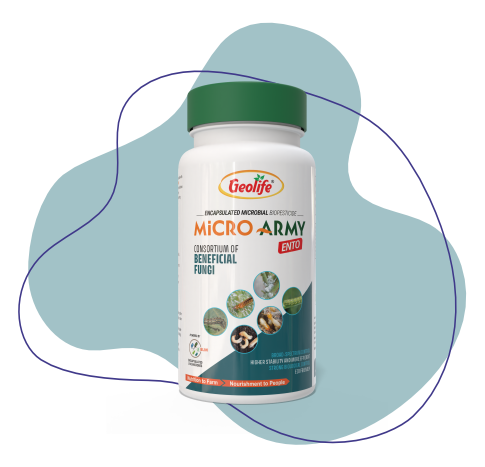
ConSortium of Encapsulated Beneficial Fungi
Mode of Action :
Cuticular Adhesion & Enzymatic Penetration : Entomopathogenicfungal spores adhere to the insect cuticle, germinate, and penetrate bysecreting proteases, chitinases, and lipases that degrade cuticular layers.
Internal Colonization & Metabolic Disruption: After penetration,the fungi proliferate within the insect hemocoel or tissues, disrupting vitalphysiological and metabolic processes.
Insecticidal Toxin Production : Produces bio-toxins such asbeauvericin and destruxins that cause feeding cessation, paralysis, immunesuppression, and eventual insect mortality.
Secondary Sporulation & Recycling : After insect death, fungisporulate on cadavers, releasing fresh infective spores that enablecontinuous infection cycles and field persistence.
Humidity-Driven Infection Efficiency : Performs optimally underfavorable humidity conditions, enhancing spore germination, infectionsuccess, and rapid pest suppression.
Benefits :
Broad-Spectrum Insect Pest Control : Effectively controls sucking and chewing pests such as aphids, whiteflies, thrips, mealybugs, termites, white grubs, and borers.
Resistance-Free Pest Management : Biological infection-based mode of action minimizes the risk of resistance development in insect pest populations.
Long-Lasting & Sustainable Control : Ensures prolonged pest suppression through spore recycling, soil persistence, and repeated natural infection cycles.
Safe to Beneficial Organisms : Non-toxic to crops, humans, livestock, pollinators, and natural enemies when applied as recommended.
Residue-free & IPM Compatible : Leaves no chemical residues on produce and integrates seamlessly into Integrated Pest Management (IPM) programs and export-oriented agriculture.
Foliar: 500 gm or 500 ml/Acre & 1.25 Kg or 1.25 Ltr/Ha
Soil: 1 Kg or 1 Ltr/Acre & 2.5 Kg or 2.5 Ltr/Ha
Foliar and Soil

301 Marathon Max, LBS Marg, Mulund-W Mumbai, Maharashtra, India – 400 080